Political Violence Roares its Ugly Head Again in Freetown

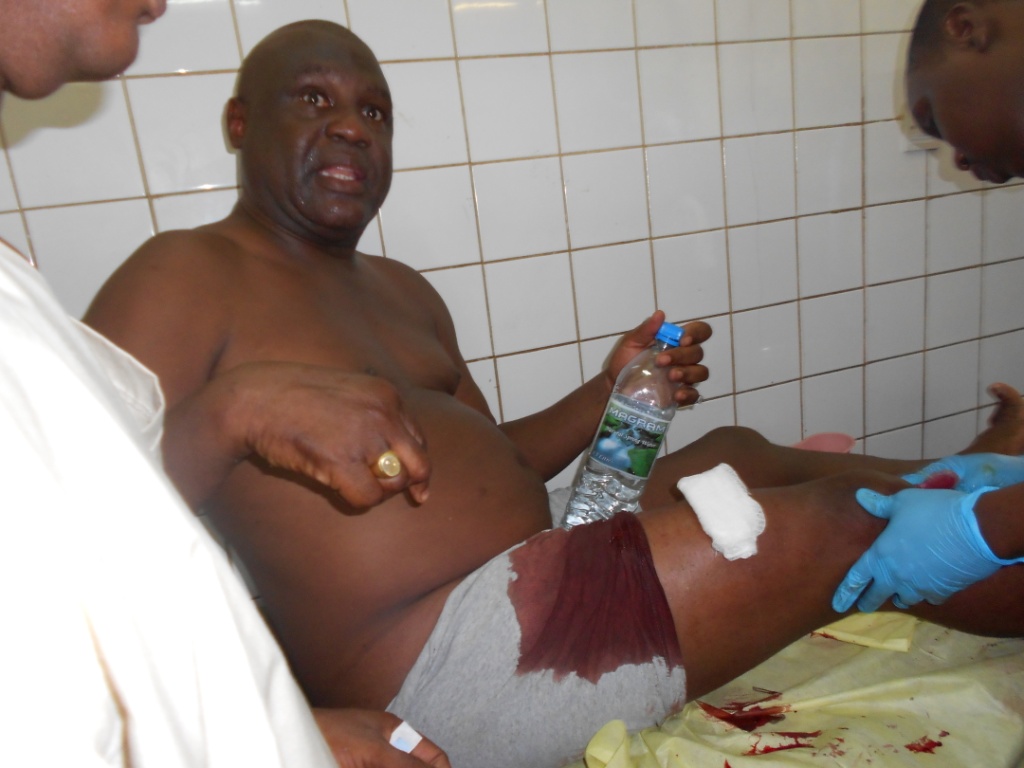
Lansana Fadika wounded in the leg
The anti-riot unit of the Sierra Leone police forces is still patrolling  the business district of Fourah Bay  in the east end of Freetown as political violence roared its ugly head again among supporters of the ruling All People Congress (APC) and the main opposition Sierra Leone Peoples Party (SLPP). It’s a sad day for politics and democracy in Sierra Leone, as ruling APC party stalwarts recover in hospital from serious wounds, sustained during a political rally at a by-election in Eastern Freetown.

It is not certain who is responsible for the violence and grievous attack on Lansana Fadika and Ibrahim Lewally – cousin of Tunde Lewally – the ruling party’s member of Parliament for constituency 104 where the by-election was being held.

Notwithstanding the police investigations, launched immediately after the assault to determine who is responsible, cross – party supporters and sympathizers have condemned the violence and are demanding a thorough investigation.

The return of political violence to Sierra Leone – in any form, after a bloody 10 year civil war must be regarded as an affront to all those whose lives were lost in defense of their democratic freedom.
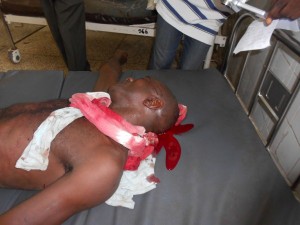
Tunde Lewally injured in the head
But more so the resurgence of political violence is an attack on the country’s fledgling democracy and the right of the people to civil liberty and freedom of association. The current wave of political violence began to be played out several months ago in Kono – the Eastern Province of Sierra Leone, where factions representing two of the ruling APC party’s ‘bigwigs’ took to the streets in a political battle for power. As opponents took to the streets, police gunshots reigned bullets on innocent citizens.

In Bo – the Southern Province of the country, the presidential candidate for the opposition SLPP, was seriously wounded on his head when his convoy was attacked, leaving scores of people injured, one dead and many properties destroyed.
Several arrests were made following the Bo violence and suspects were charged to court, including the opposition member of Parliament – Radoe Yokie.
Today’s violence took place at a rally organised by ruling APC party supporters – including Lansana Fadika and other members of the opposition SLPP who defected last year from the party.

Ironically, just twenty-four hours ago, Fadika and his fellow defectors were accused of ‘betrayal and political prostitution’ after a street march to the ruling party’s office at Brookfields, where they officially declared their support for APC.

Speaking at the APC head office yesterday, to the executives and loyal members of the APC, Fadika said: “I want you to know that the APC is not strange to me, when my father died in 1980, APC was the party that did all the necessary arrangements and he was given a befitting funeral”. He promised “to work with APC to crush the SLPP to death”.

According to local newspapers, Fadika was dressed in a red shirt with a picture of President Koroma,  as he removed his foot wear and climbed unto a chair to address the APC crowd.
 He sang: “fire fire fire fire dae cam” and “no hiding place down there”; after which he said: “dem wan ya dem go sabi we tiday” – “we dae finish SLPP”.
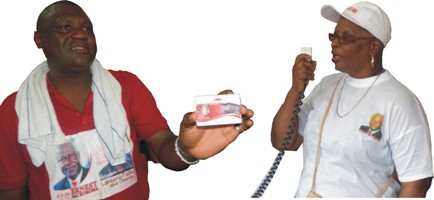
Fadika becomes full member of APC
Political observers believe that Fadika’s defection – along with over 100 members of SLPP’s Western Area caucus, came as a result of their flagbearer candidate – Usu Boie Kamara – failing to be elected as the party’s presidential candidate for elections slated for Novembver 2012.

Supporters of the ruling APC are now accusing the opposition SLPP of perpetrating. While the opposition SLPP executives are yet to issue a statement on the violence, unconfirmed sources say that the SLPP’s leadership have condemned the violence and distanced the party from the grievous bodily harm inflicted on Fadika and Brima Lewally.

The central government has not yet made a public statement either, but there is little doubt that it too will swiftly condemn the violence and call for a thorough police investigation, leading to the arrests of those responsible.

Also, some observers have expressed shock and dismay at the intensity of the violence in Freetown , as it comes just a few weeks after the Chief of Police – Francis Munu – unbanned all political activities held in public.

The ban was promulgated, following the enquiry reports into the causes of the Bo and Kono violence.

Political analysts however are questioning the government’s persistent failure to implement the recommendations of the Shears Moses commission of enquiry report into the political violence, which erupted in Freetown a few years ago.

In September 2011, in response to widespread criticism for failing to implement the recommendations of the Shears Moses report, president Koroma replied that the Attorney – General was in the process of taking all necessary action in that regard.

Four months on, yet another political violence has erupted in the country’s capital, Freetown.
With presidential, general and local elections just ten months away, today’s violence in the capital will most certainly send shivers down the spines of law abiding citizens, who simply want to exercise their right to elect who governs them, without fear or the threat of violence.

 

Share
About Othman Sheriff 350 Articles
Othman Sheriff is an experienced Sierra Leonean development professional, peacebuilding practitioner, professional journalist and human rights advocate with over two decades of engagement in community development, youth empowerment, education, humanitarian assistance and international development cooperation. Born and raised in Kenema District, Eastern Sierra Leone, he has dedicated much of his professional career to improving the socioeconomic conditions of vulnerable and marginalised populations, particularly disadvantaged young people, women, children and underserved rural communities. As the Founder and Programme Director of Youth in Action for Development (YAD), Sheriff has played a leading role in mobilising international development assistance and coordinating community-driven interventions aimed at poverty reduction, sustainable livelihoods, social inclusion and grassroots development. Over the years, he has facilitated the mobilisation and implementation of development projects worth billions of Leones, supported by international development partners, including European development institutions, humanitarian organisations and United Nations agencies. A committed advocate for free and inclusive Technical and Vocational Education and Training (TVET), Sheriff spearheaded the establishment of the Youth Resource Academy (YRA) in 2018, through which he has championed access to practical, employment-oriented education for underprivileged youth, particularly young women, school dropouts, single mothers, widows, unemployed youth and individuals from economically disadvantaged households. So far, the Academy has provided vocational, technical and entrepreneurship training opportunities to more than 2,000 youth helping them acquire marketable skills, pursue self-employment and improve their economic independence. He also solicit funds to provide start up kits for the youth who graduated from the academy. In addition to his development and humanitarian work, Sheriff serves as the Editor-in-Chief and CEO of Critique Echo Newspaper, using journalism as a platform to promote accountability, responsible governance, social justice and public awareness of critical socioeconomic and human rights issues. He is a dedicate member of many international peacebuilding networks including the United Religions Initiative (URI), International Association of Educators for World Peace (IAEWP), Intercultural Leaders Network of the United Nations Alliance of Civilisations (UNAOC)`s Youth Solidarity Fund, and the alumni Association of King Hamad Youth Empowerment Awards. Through his leadership, advocacy and international partnerships, Sheriff continues to champion a vision of Sierra Leone in which disadvantaged young people have equitable access to education and economic opportunities, women and girls live free from violence and discrimination, human rights are respected, and communities are empowered to pursue peaceful, inclusive and sustainable development.

Be the first to comment

Leave a Reply

Your email address will not be published.


*


This site uses Akismet to reduce spam. Learn how your comment data is processed.